The Digital Blueprint: How 3D Modeling Services Streamline the Product Development Lifecycle Today companies face immense pressure to innovate rapidly, reduce costs, and accelerate time-to-market while maintaining impeccable quality. Traditional product development workflows, often reliant on lengthy physical prototyping and sequential hand-offs, can be slow, expensive, and prone to errors. This is where 3D Modeling Services emerge as a transformative force, acting as the digital blueprint that fundamentally streamlines the entire product development lifecycle. By creating precise, versatile, and highly visual digital representations of products, 3D Modeling Services empower designers, engineers, marketers, and manufacturers to collaborate more effectively, iterate faster, and make more informed decisions at every stage, ultimately leading to superior products launched with greater efficiency. The Traditional Bottlenecks in Product Development Before delving into the solutions offered...
How Can 3D Rendering Help in Designing of 3D Furniture Visualization?
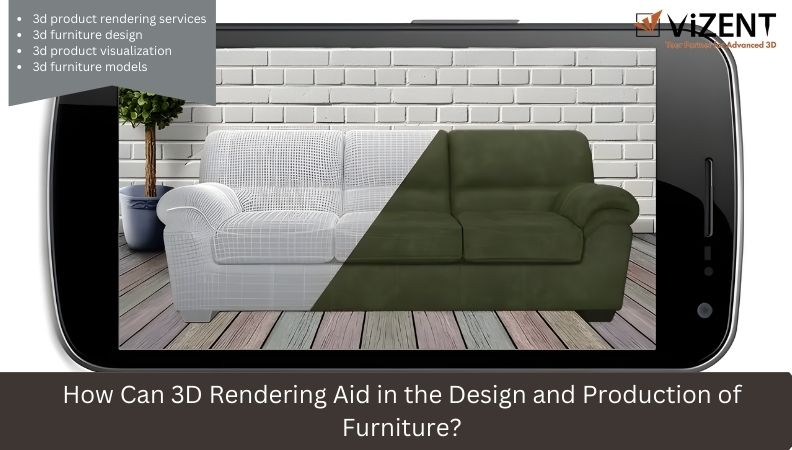
3D Design and Production of Furniture
The development of 3D product rendering services has led to a considerable evolution in the furniture sector. Physical prototypes were frequently used in traditional design and production processes, which were expensive and time-consuming. With speedier and more effective workflows, 3D product visualization has now revolutionized the design, testing, and marketing of furniture. Let's examine how 3D furniture rendering and design are essential to the production of contemporary furniture.
1. Improving Design and Concept Development
Designers may produce intricate digital prototypes of furniture using 3D before manufacturing starts. Designers can see the finished product in a lifelike virtual environment thanks to 3d furniture models, which eliminates the need for expensive prototypes or paper sketches. This makes it easier to experiment with materials, improve designs, and make changes without wasting money.
2. Producing Superior 3D Furniture Models for Manufacturing
In the production process, precise 3d furniture design are crucial. Manufacturers may guarantee that every piece of furniture is made precisely as planned by using accurate dimensions, textures, and structural features. Before manufacturing ever starts, realistic images from 3D product rendering services help with material selection, durability testing, and structural integrity analysis.
3. Using 3D Product Visualization to Enhance Marketing
Conventional furniture marketing photography necessitates costly studio setups, numerous prototypes, and logistics. These difficulties are removed by 3D product visualization, which enables companies to produce beautiful, lifelike pictures of their furniture without the need for physical manufacturing. In a virtual setting, businesses can display a variety of colors, textures, and styles, which enhances the appeal of online catalogs and marketing efforts.
4. Cutting Manufacturing Process Costs and Time
Furniture producers can drastically reduce expenses related to material waste and production errors by utilizing 3D product rendering services. Prior to the start of actual manufacture, virtual prototypes enable testing for possible design problems. This speeds up the entire manufacturing cycle, lowers the chance of faults, and decreases material waste, all of which result in a quicker time to market.
5. Facilitating Cost-Reduction and Virtual Prototyping
By enabling virtual prototyping, 3D rendering removes the need for numerous physical prototypes. Before spending money on tangible examples, designers can test materials, structural integrity, and aesthetics. This guarantees that only the best designs proceed to production while cutting costs and speeding up product development.
In conclusion
3D product rendering services have revolutionized furniture design and manufacturing from concept visualization to final production. Businesses can produce creative, affordable, and market-ready furniture more quickly than ever before by utilizing 3D furniture design, 3D product visualization, and accurate 3D furniture models.
Comments
Post a Comment